Windows 11 KB5077181 Network Loss and DHCP Error After February 2026 Update
Fix Windows 11 KB5077181 network loss, DHCP error, and no internet after the February 2026 update. Reset DHCP Client, flush DNS, and restore connectivity.
What is the KB5077181 Network/DHCP Failure?
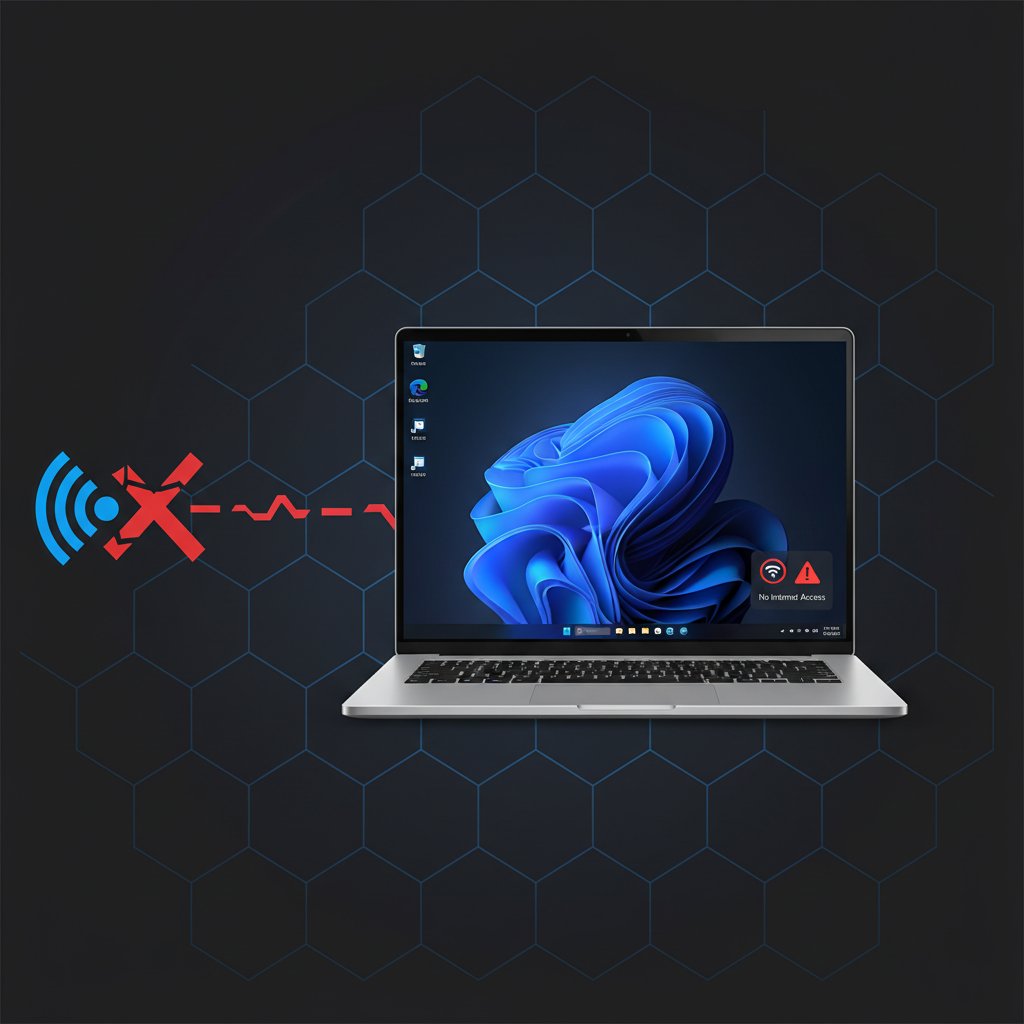
After installing Windows 11 update KB5077181 (released February 10, 2026), some PCs lose all network connectivity even though Wi-Fi or Ethernet shows as "Connected." The taskbar displays a Wi-Fi or Ethernet icon with no internet access. The root cause is a broken DHCP Client service — the update disrupts the service registration or binary, preventing your router from assigning an IP address to your PC. Your machine appears connected at the link layer but has no IP routing or DNS configuration.
This issue is distinct from the KB5077181 boot loop problem. Your PC boots and logs in normally, but you have no internet access — which makes it harder to search for fixes. This article provides offline-ready solutions.
When does it occur?
- After KB5077181 installs and the PC restarts — Wi-Fi or Ethernet shows "Connected, no internet"
- Network icon in the taskbar shows a yellow warning triangle or "No Internet" label
- Web browsers display "DNS_PROBE_FINISHED_NO_INTERNET" or "ERR_NAME_NOT_RESOLVED"
- VPN clients fail to connect or report "No network adapters available"
- On both Wi-Fi and wired Ethernet connections simultaneously
- On Windows 11 24H2 (build 26100.7840) and 25H2 (build 26200.7840)
Common causes
- DHCP Client service broken by the update — KB5077181 modifies a dependency that prevents the DHCP Client service from starting, so your PC cannot obtain an IP address from the router
- SENS service failure cascading to network — the System Event Notification Service (SENS) and DHCP Client share early-boot dependencies; SENS failure can prevent DHCP initialization
- DNS cache corruption — stale DNS entries from before the update conflict with the new network state
- Winsock catalog corruption — the update can leave the Windows networking stack in an inconsistent state
- TCP/IP stack misconfiguration — the update resets or corrupts TCP/IP registry entries
- Network adapter driver conflict — KB5077181 may install a generic network driver that conflicts with the manufacturer's driver
Step-by-step fixes
- Restart the DHCP Client service — Press Win+R > type
services.msc> press Enter. Scroll to "DHCP Client". Right-click > Properties. Set Startup type to "Automatic". Click Stop, wait 5 seconds, then click Start. If the service fails to start, note the error code — this confirms KB5077181 broke the service binary.
- Flush DNS and reset network commands — Open Command Prompt as Administrator (right-click Start > Terminal (Admin)) and run these commands one at a time:
- ipconfig /release
- ipconfig /flushdns
- ipconfig /renew
- netsh winsock reset
- netsh int ip reset
Restart your PC after running all commands.
- Reset the TCP/IP stack — In the same Administrator Command Prompt, run:
netsh int ip reset resetlog.txt. This resets all TCP/IP registry values to their defaults. Restart your PC. This fixes cases where the update corrupted TCP/IP configuration entries.
- Re-register network DLLs — In Administrator Command Prompt, run:
- regsvr32 netshell.dll
- regsvr32 netcfgx.dll
- regsvr32 netman.dll
These re-register core networking components that the update may have deregistered.
- Manually assign a static IP — If DHCP cannot be fixed, bypass it temporarily. Go to Settings > Network & Internet > Wi-Fi (or Ethernet) > your connection > IP assignment > Edit. Set to Manual, enable IPv4. Enter: IP address 192.168.1.100 (or another unused address on your network), Subnet mask 255.255.255.0, Gateway 192.168.1.1 (your router's IP), Preferred DNS 8.8.8.8, Alternate DNS 8.8.4.4. This restores internet access while you work on a permanent fix.
- Uninstall KB5077181 — Go to Settings > Windows Update > Update History > Uninstall updates. Find "Security Update for Microsoft Windows (KB5077181)" and click Uninstall. Then go to Settings > Windows Update > Pause updates for at least 5 weeks to prevent automatic reinstallation.
- Full network reset — If all else fails, go to Settings > Network & Internet > Advanced network settings > Network reset. Click "Reset now". This reinstalls all network adapters, resets all networking components to factory defaults, and restarts your PC. You will need to reconnect to Wi-Fi and re-enter passwords.
- Update or reinstall network adapter driver — Open Device Manager (Win+R >
devmgmt.msc) > Network adapters. Right-click your Wi-Fi or Ethernet adapter > Update driver > Search automatically. If that doesn't help, right-click > Uninstall device (check "Delete the driver software"), restart, and Windows will reinstall the driver fresh.
If it still doesn't work
If none of the above restores connectivity, the DHCP Client service binary itself may be corrupted beyond repair by the update. Run sfc /scannow and DISM /Online /Cleanup-Image /RestoreHealth from an Administrator Command Prompt — though note that DISM needs internet access, so you may need to tether your phone's connection via USB first. As a temporary workaround, use your phone as a USB tethered hotspot to get online while you wait for Microsoft to release a corrective patch. Monitor the Windows Release Health dashboard at learn.microsoft.com/windows/release-health for official acknowledgment of this network issue.
Related errors
Fix Windows 11 KB5077181 boot loop after the February 2026 update. Step-by-step recovery for SENS login errors, error 0x800f0983, and restart loops.
Resolve Windows 11 WiFi showing connected but no internet access after updates. Fix network adapter issues, DNS problems, and driver conflicts preventing internet connection post-update 2025.
Fix Bluetooth not working or missing from Device Manager after the Windows 11 January 2026 KB5074109 update. Restore Bluetooth connectivity and audio devices.